

With this letter, I would like to address all those who have dedicated themselves to teaching. Choosing to convey a message of peace and harmony in our world requires a certain amount of courage, and I want to express my admiration and gratitude to you.
Becoming what others will take to heart to call “sensei” requires selflessness and generosity. For those of you who have chosen to teach Kobayashi sensei’s aikido, this start of the fall semester must be a cause for celebration.
Indeed, we enjoy the privilege of understanding the transformative power of the techniques in our practices—aikido and aikishintaiso—and we are enthusiastic about the prospect of the new relationships we will be able to forge.
The energy of the new season lies in the coming together of newcomers with diverse aspirations and long-time practitioners who draw on their experience to welcome them. It is also the meeting between the teacher and the aspiring student—an encounter full of promise and mutual commitment.
The Ethics of the Teacher in the Aiki School
I would like to reiterate a few essential points that form the foundation of the teacher’s ethics in our aiki school.
Master Kobayashi placed the following above all else: aikido must set one free. If you cannot contemplate a student leaving you without being affected by it, you are not ready to teach. People come of their own free will and must be able to leave of their own free will.
Thus, we understand why we must forge relationships that adhere to the requirements of an etiquette which establishes appropriate boundaries—that is, boundaries that allow for balanced relationships in which each person remains free from the other.
We must also apply a principle that can be summarized as follows: no one has the right to tell another person what they should be or should become. The myth of personal development pervades our society and, consequently, our dojos. We must not allow illusions to take root that can turn into disappointment—illusions rooted in the belief in the superpowers of the teacher or the practice itself. The student who doubts is not the hardest to guide. It is the one who wants to place the power over themselves in your hands who is at risk—and who puts you at risk if you do not know how to balance the relationship, particularly by clearly defining its boundaries.
Teaching Aikido in a World in Search of Meaning
Our world is marked by violence and the frantic search for identity that it provokes. When I first began teaching, many people came to learn self-defense. The beauty and complexity of aikido are such that it was not difficult to guide them toward a peaceful path that prioritizes harmony in all things. They readily let go of their desire for conflict and the fears that had fueled it. Today, motivations are much more varied and often deeply unconscious, and desires for esotericism, magical techniques, and superpowers can find fertile ground to flourish within the very beauty and complexity of our aikido. Without reverting to aikido as self-defense, be pragmatic. “Don’t let yourselves be swept up” in mystical-philosophical discourse that unwittingly implies a promise you cannot keep—and must not make. Indeed, we must never doubt—nor allow others to doubt—that budo(s) are, above all, a process of self-education, and that “it is the student himself who will rise” through practice. Your role, though modest, consists above all in helping them avoid misunderstandings, particularly by demystifying our practice whenever you have the opportunity, without crushing their dreams.
The Inauguration of the Kumatori Dojo in Japan
The start of the new season this year is marked by the inauguration of the Kumatori Dojo in the southern suburbs of Osaka.
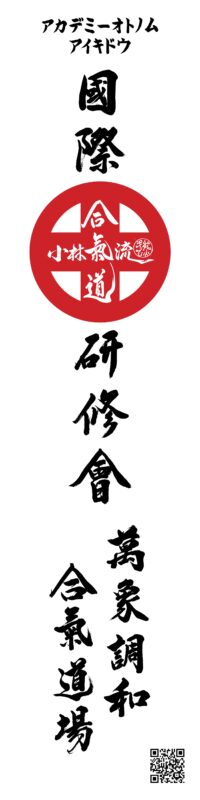
After consulting with several experts, I decided to officially name it Bansho Chôwa Aikidojo, which can be translated as “Dojo of Harmony in All Things.” (The illustration shows the sign indicating the dojo’s location.) Of course, in common usage, this name will most likely be shortened, as is the case with the Hombu Dojo. Never mind. The name will remain, and it quite clearly expresses our vision, which I will summarize in this simple sentence: Our aikido demonstrates that, unlike violence, harmony is effective.
The inauguration of this facility will take place on November 21 in the presence of prominent figures representing the Japanese and French governments.
It will be followed on the 22nd by an open house for the local community.
Aikishintaiso and Aikiken Workshops
Prior to the opening ceremony, the first Aikishintaiso workshop will take place. It is open to everyone, and you can still register. Following the inauguration, there will be an aikiken workshop. If you’d like to participate, please register as soon as possible. To register for either workshop, send an email to aa************@****do.fr expressing your interest. You will then receive further instructions.
Be among those who can say, “I was there.” I look forward to seeing many of you.
A Historic First: 3AKH Establishes Itself in Japan
The founding of 3AKH marked a first in the history of aikido. It amounted to asserting that a school dedicated to a specific style of aikido could exist in a world where standardization was already the norm, and where the sportification of the art had begun to erode its roots. To make this claim in Japan, drawing on the unique characteristics of Kobayashi Sensei’s aikido to legitimize it, will also be a first. It has been a very long time since any ryu established a dojo there. It is a very significant and deeply moving moment to bring the creation of 3AKH Japan to fruition through the opening of this dojo. We have dedicated a dojo in France to Kobayashi Sensei’s aikido. Now we are going to give him one in his homeland. It’s only fitting. By doing this, I am responding to his explicit request, which he made many times: “Go teach my aikido in Japan; otherwise, it will disappear there.” Keeping his aikido alive means keeping him alive and continuing to express our respect and gratitude to him. So, I repeat: I look forward to seeing many of you there.
Join the Dai Nippon Kobayashi Hirokazu Aikido Shinko Kiko (DNKHA)
Our Japanese association, Dai Nippon Kobayashi Hirokazu Aikido Shinko Kiko (DNKHA), has been recognized as an Ippan Shadan Hojin—that is, a “general association incorporated as a legal entity”—and has officially adopted “Autonomous Aikido Academy of Japan” as its second name. I am co-president of this association, which is officially a subsidiary of 3AKH. Several members of the 3AKH executive committee will also serve on the DNKHA executive committee.
You can now, if you wish, become a member of our second academy via this link: Join DNKHA
In doing so, you will help advance Kobayashi Aikido in Japan, and I thank you for that. The more we strengthen our presence in Japan, the more we will ensure the long-term future of our school.
A wonderful start to the new season to all
I wish you a very good start to the new season, many students, great success, and many new discoveries in your teaching.
I look forward to seeing you in London, Lyon, Szczecin, Efe, Vienne, and Iat—and, of course, in Kumatori.
Cognard Hanshi
More articles and news
- Colloque le vendredi 2 octobre 2026 à Lyon – « L’éthique pacifique des arts martiaux japonais »
- Dojo in Japan : Historic Inauguration in Kumatori, November 2026
- L’Académie Autonome d’Aikido obtient le statut d’association d’intérêt général